I just wanted to share these other links for you to help you get a better understanding of Greek Mythology.
1.
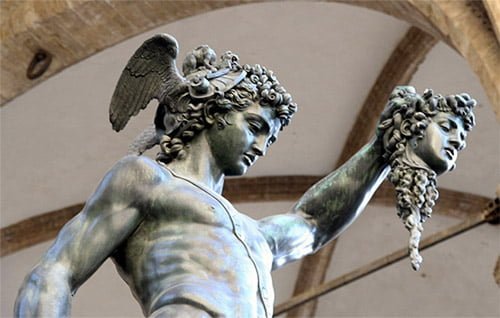
The Story of Perseus and Medusa
2.
The Labors of Hercules! - an interactive presentation where you choose the dialogue for the pictures and create a comic!
I am also posting the stories from the Handouts in Class for you to complete your In-Class Greece Activity on performing a short play based on Greek Mythology: Due for 9.1 on Friday.
1.
Eros and Psyche
One day on Mount Olympus, Aphrodite decided she had become fed up with the beauty of Psyche, the maiden. Psyche was very beautiful and was often complimented for her beauty. Aphrodite wanted to set her straight. So she called her son, Eros, to shoot one of his arrows, which poisoned immortal and mortal alike with love, at Psyche, while she was sleeping. "What is the point of shooting an arrow at her when she is asleep?" asked Eros.
"When she wakes up," replied Aphrodite "I will be sure to supply her with someone like the castle dwarf, or maybe a donkey. Yes, that's a possibility."
"That is a cruel trick," said Eros.
"It is meant to be cruel. Now go and obey your mother," replied Aphrodite.
When Eros was above the sleeping Psyche, he took out an arrow and prepared to shoot it. But he accidentally poked himself with the arrow, and all of a sudden Psyche was the most valuable and wonderful thing the earth had ever created. He loved Psyche more than anyone or anything in the world. He flew back to Mount Olympus, leaving Psyche unaffected.
Aphrodite was furious at Eros for not complying with her orders. The fight that followed was one of the worst Olympus, or for that matter, the world, had ever seen. While Eros was sulking, no one fell in love and Aphrodite began to wither. So eventually Aphrodite saw that Eros must have his way. "What is it you wish?" she asked him.
"The girl," replied Eros. "You shall have her," said Aphrodite.
So Aphrodite had Zephyr, the west wind, come and bring Psyche to Eros. But Eros could not be seen by Psyche for a little while after their marriage. When Psyche's sisters visited her, they convinced Psyche that her invisible husband was a monster. Psyche, curious, brought a candle into her husband's bedchamber and looked at him. It was Eros, the god of love. In her shock, Psyche let a drop of candle wax drip from the candle. Eros awoke with a start and became very angry with Psyche. "Yes, I am love itself, and I cannot live where I am not believed." Then Eros left.
But eventually Eros forgave Psyche and invited her back to live with him, and Psyche was made immortal upon Eros' request. Psyche is now the goddess of the soul, and that is where we get the prefix "pysch-", as in psycho, psychology, and psychiatrist.
2.
Apollo and Cassandra
The Temple at Delphi was the most famous of all Apollo's Temples. But it was not the only temple built for Apollo. There was a wonderful temple in Troy, built by the people of Troy in his honor, back when Troy and Greece were friends, before the Trojan War.
As the story goes ...
Apollo enjoyed showing up now and then at the various temples around ancient Greece built in his honor. One day, Apollo swung by the temple in Troy.
Cassandra, a young and beautiful priestess, worked at the temple. The minute Apollo saw Cassandra, he fell in love. (Love at first sight ran in the family. After all, Apollo was Zeus’ son.)
Apollo offered Cassandra a deal. He would give her a very special gift, the gift of prophecy - the ability to see the future - if she would give him a kiss.
Cassandra thought that was a great deal. With a laugh, Apollo gave her his gift. Instantly, Cassandra could see the future. She saw Apollo, in the future, helping the Greeks destroy Troy. When Apollo bent his head to gently kiss her, she angrily spit in his face.
Apollo was furious. He could not take away his gift. That's not how it worked. But he could add to it.
Although Cassandra could, forever after, see the future, no one would believe her. That was his added gift. And no one did. When Cassandra begged her people in Troy to watch out for the Trojan horse, not one person believed her. 3.
Aphrodite and the Trojan War
Everyone knew that Zeus was probably Aphrodite's father. Everyone knew that Zeus was probably Helen's father as well. That made Helen her half sister. But Helen's mother was only a mortal. Aphrodite's mother was probably a goddess. There really was no comparison.
When Aphrodite heard that Paris, a prince of Troy, had proclaimed her half sister Helen as the fairest in the land, well, Aphrodite was not at all pleased.
A short time later, a wedding was announced in the Greek god world. Eris, the spirit of disagreement, had not been invited. Eris made a surprise and most unwelcome visit to the wedding reception. She threw a golden apple of discord on the feasting table. "This apple is for whomever is the fairest," Eris proclaimed haughtily, hoping to cause trouble. Which she did.
Hera, Aphrodite, and Athena all grabbed for the apple. "It's mine," insisted the three goddesses, Aphrodite loudest of all.
Zeus thundered, "Enough. Paris will decide who is the fairest. Hermes, go tell Paris he has a job to do."
"Paris!" Aphrodite muttered. "Well, well."
Paris found himself facing three of the most powerful goddesses in the world, all clamoring for his attention. "Paris will decide! Which one of us is the loveliest, Paris?" they demanded to know.
Paris could have said they were all the most beautiful. But Paris was as foolish as he was handsome. Paris told all three goddesses that whomever offered him the best bribe would be declared the fairest.
"I'll show him a bribe," hissed Hera.
"Hera, Athena" Aphrodite pleaded. "Let me be the one to teach him a lesson."
Aphrodite's bribe was the best. She promised Paris that she would make the king of Sparta's wife, the beautiful Helen, fall instantly in love with Paris, and wouldn't his brothers be jealous!
Aphrodite kept her promise. That very day Paris and Helen left Greece behind, and traveled together to the city of Troy, where they expected to live happily ever after.
When the king heard what had happened, that his wife had been kidnapped by Paris, a prince of Troy, the king of Sparta went after his wife to rescue her. When the king of Sparta called on the other kings of Greece to help, they rallied to his side. A huge navy of Greek warriors set sail for Troy. That was the beginning of the Trojan War. And the end of Troy.
Ever after, and for all time, Queen Helen of Sparta, the women who caused the destruction of an entire city-state, was no longer known as the half sister of Aphrodite. She was known simply as Helen of Troy.
4.
Zeus, Hera and Io
Once upon a time, a long time ago ...
Zeus, Poseidon, and Hades were the three sons of Cronos. When Cronos retired, the boys divided the world up between them. Zeus took the sky, Poseidon took the sea, and Hades ruled under the earth, the home of the dead. At first, it was great fun. But things had been just a bit slow lately.
Zeus thought about what he could do.
He could turn himself into an octopus and visit his brother Poseidon under the sea, but he didn't feel much like a swim.
He could visit Hades under the earth, but Hades was such a gloomy fellow.
He could hurl thunderbolts, but it wasn't much fun without a target.
He could hunt up one of the other gods. But the truth was, all the other gods were terrified of Zeus. He did have a terrible temper, but only when someone lied to him. Since the gods often lied, they mostly avoided Zeus.
He could call for his wife, Hera. But the truth was, Zeus was a little frightened of his wife, Hera.
He could find a beautiful woman. But he couldn't let Hera catch him. His wife Hera was very very jealous.
Zeus flew down to earth and looked around for something to do. He spotted two men walking along a lane. Zeus cast his voice to make it sound like somebody else was speaking. He was very good at that.
"Hey stupid," Zeus cast his voice loudly, hoping to start a fight.
One man turned to the other angrily. "What did you say?" And before you could say Zeus, fists were flying. Zeus found that very funny.
A glint on the river caught his eye. It was Io, a lovely river nymph.
"What a lovely young woman," Zeus said. He promptly fell in love.
Hoping to hide himself from the eagle eye of his jealous wife, Zeus covered the world with some really thick clouds. Then he flew down to Io. But Hera was not stupid. The thick coat of clouds made her suspicious immediately.
Zeus looked up. "It's Hera!" he gulped.
Quickly, Zeus changed Io into a cow. When Hera landed, all she found was an innocent looking Zeus standing next to a little white cow.
"This little cow appeared out of nowhere," he told his wife, acting surprised.
Hera was not fooled. "What a beautiful cow," she gushed admiringly. "May I have it as a present?"
Not knowing what else to do, Zeus had to agree. Hera sent the cow away under guard.
Zeus arranged for Io to be rescued and set free. He sent his son Apollo to sing the guard asleep. When the guard closed his eyes, Io ran away.
When Hera heard about it, she sent a gadfly after Io. A gadfly is a fly that bites.
"Moo moo," Io screamed, when the gadfly found her.
Io swam across a sea, hoping the gadfly would drown on the trip. No such luck, although Hera did name the sea between Greece and Rome after Io. Perhaps you've heard of it - the Ionian Sea? No matter.
Feeling very sorry for herself, a dispirited Io traveled next to Egypt.
It was then that Hera decided that Io had suffered enough. First, she made Zeus promise that he would never see Io again. Then she changed Io back into human form, and left her in Egypt.
Egypt was a dismal place for a river nymph. There are crocodiles in the Nile.
Back in Greece, Zeus gave a big sigh. Surely there w as something he could do ....